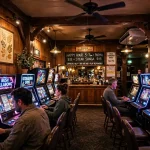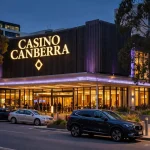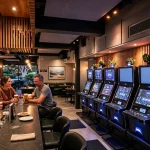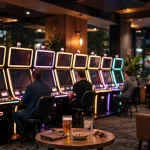
The phrase can refer to a gaming area, but it does not identify a specific business or confirm its licence.
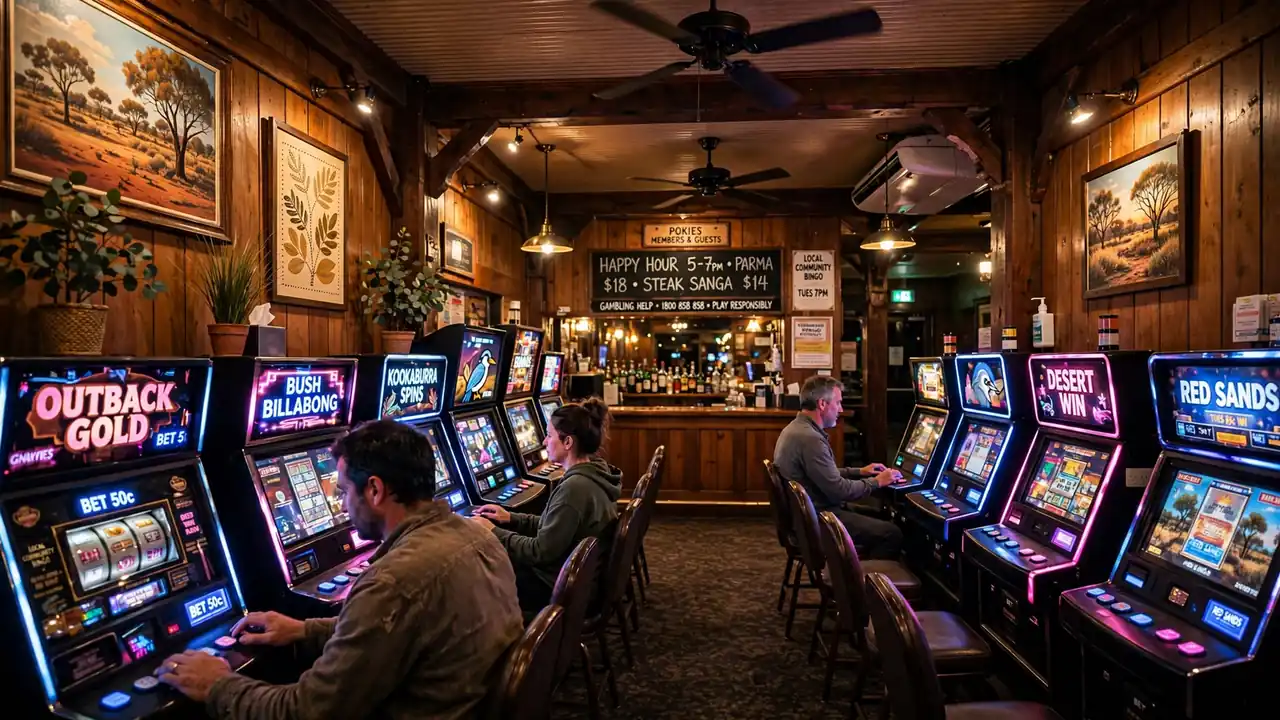
In Australia, “pokies” is a familiar term for gaming machines. A “pokies parlour” therefore suggests a place where those machines are available, or a casino-style gaming area within a larger venue. It is a descriptive phrase, not a reliable name for a specific business or a formal category that tells you what licence a venue holds.
That distinction matters when you encounter the phrase on a sign, in a directory or on a website. The words may point to a physical gaming venue, but they do not, by themselves, confirm that a particular brand operates a casino in Australia. Nor do they tell you whether the material is about a land-based venue, an online service, or simply a page using familiar Australian terminology.
A physical casino is a place you can enter, with its own location, operating arrangements and entry conditions. In that setting, “parlour” may describe a gaming room or the general atmosphere of a dedicated gaming area. It can also be part of informal wording used to distinguish a venue from other kinds of entertainment or hospitality businesses.
Choosing a pokies parlour-style casino in Australia is easier when you know what information is available about each option. Use these short verdicts as a starting point, and check the details that matter to you before signing up.
SpinsUp
SpinsUp is listed with a Curaçao Gaming Control Board licence held by Dama N.V. This gives you a clear licensing detail to consider.
LevelUp Casino
LevelUp Casino is listed with a Curaçao eGaming licence held by Dama N.V., and its minimum deposit is A$15. Those details give you a quick starting point for checking whether it suits your plans.
Rollero Casino
Rollero Casino is listed with a Curaçao Gaming Control Board licence held by Hollycorn N.V. You can use that licensing information when assessing the site.
SkyCrown
SkyCrown is listed under the Tobique Gaming Commission. Its stated payout times are around 10–15 minutes for crypto and 1–5 days for fiat, with a minimum deposit of A$30.
Wild Tokyo
Wild Tokyo is listed as Curaçao-licensed, with a minimum deposit of A$10. Its stated payout times are 30–60 minutes for crypto and 1–5 days for fiat.
Kingmaker
Kingmaker’s listed minimum deposit is A$30. Stated payout times are around 90 minutes for crypto and 1–5 days for fiat.
MrPacho
MrPacho has a listed minimum deposit of A$30. Its stated payout times are 30–120 minutes for crypto and 24–72 hours for fiat.
House of Pokies
House of Pokies lists an international iGaming licence, though the jurisdiction is not named. PayID payouts are stated as taking 1–24 hours; the minimum deposit is A$30, or A$10 when using PayID.
Uptown Pokies
Uptown Pokies is listed as Curaçao-licensed and operating since 2017. Its minimum deposit is A$20.
Golden Pokies
Golden Pokies is listed as Curaçao-licensed. That is the available detail to consider when deciding whether to look into it further.
The phrase is less precise than the venue’s actual name and details. If you are trying to identify a place, useful questions are concrete: Is there a physical address? Does the information describe a land-based venue? Does it state who operates it and which jurisdiction is responsible for its licence? “Pokies parlour” alone answers none of those.
A casino and a gaming room should not automatically be treated as interchangeable labels. The phrase may be used loosely, while the legal and operational identity of a venue depends on details beyond its promotional wording. A page calling itself a parlour casino does not establish that it is a casino property. Labels are easy to print. Verification takes more.
The same caution applies to “pokie parlour,” the singular form. It may refer to a place associated with gaming machines, but the wording is not proof of a separate venue type. If the phrase appears without an identifiable location or operator, you have a description without much substance.
The wording does not tell you how many machines a place has, what facilities are on site, or what access rules apply. Those details vary by venue and should be checked against information specific to the property. You should not infer a room layout, a particular range of games, or an exclusive service from the word “parlour.”
It also does not settle whether a result is about a physical property at all. A website may use casino language without representing a land-based Australian venue. The name and imagery can resemble those of a physical gaming room, yet that resemblance is not evidence of a local casino operation. Keep the distinction simple: a phrase describes; a verifiable venue record identifies.
For a physical visit, age is one firm baseline: casino entry in Australia is restricted to people aged 18 or older. Major Australian casinos operate around the clock, but that general operating pattern does not answer every practical question about a particular venue, its services or access arrangements. Check the property’s own current information for those details rather than treating a broad label as a complete guide.
When you see “pokies parlour casino,” separate the phrase into what it can reasonably suggest and what it cannot prove:
| The wording may suggest | It does not establish |
|---|---|
| A place associated with gaming machines | That a named property exists at a physical address |
| A casino-style gaming area or venue | That a particular website represents an Australian casino |
| Informal, locally recognisable terminology | The venue’s operator, licence or entry conditions |
This is a useful distinction whether the wording appears in a business description, an article or a brand name. The more the claim matters to your decision, the less you should rely on the label alone. Look for the actual property identity and the details attached to it.
There is no special meaning hidden in the spelling difference between “pokie” and “pokies.” Both forms can appear in everyday descriptions, but neither turns a broad phrase into an official status. “Parlour casino” is similarly suggestive rather than conclusive: it may describe a casino-like setting, but the words are not a substitute for evidence about the venue.
Treat “pokies parlour” as a starting description, not a verdict. For a physical casino, the relevant comparison is between the name used and the identifiable property behind it: its location, operator and stated entry information. If those details are absent, the phrase has not done the job of identifying a venue. A label is not a licence.
Attention: The phrase "pokies parlour" is a descriptive label and not proof of a specific business, a formal category, or a legal licence.
Australia’s casino venues are spread across the country rather than concentrated in one region. A specialist casino review describes more than 20 full-scale casinos across all eight states. That is a snapshot from one review, not a permanent national register: venue lists and classifications can change, and a count depends on what the source includes as a casino.
The same distinction matters when comparing national and city figures. A specialist review identifies Sydney, in New South Wales, as Australia’s largest gambling city and counts 11 gambling facilities there. That wording refers to facilities, not necessarily 11 full-scale casinos. A city-level count and a national casino count answer different questions, so they should not be treated as interchangeable measures.
For a physical venue, the useful geographic detail is its named location. Lasseters Casino is at 93 Barrett Drive in Alice Springs, Northern Territory. Jupiters Gold Coast Casino & Hotel is on Broadbeach Island, on the Gold Coast. These examples place venues in very different settings: one is in an inland Northern Territory city, while the other is on Queensland’s coast. The address helps you identify the property; the broad regional label helps you place it.
| Venue | Location |
|---|---|
| Lasseters Casino | 93 Barrett Drive, Alice Springs, NT 0870, Australia |
| Jupiters Gold Coast Casino & Hotel | Broadbeach Island, Gold Coast |
A useful comparison starts by separating three things: the state or territory, the city or region, and the venue’s own address. “Gold Coast” gives a regional frame; Broadbeach Island narrows it to the venue’s location. “Alice Springs” identifies the city; Barrett Drive provides the street address. Keeping those levels separate makes a directory easier to read and prevents a broad destination name from standing in for a precise location.
The spread across jurisdictions is also relevant when you are comparing physical casinos. Australian casino properties operate under licences issued by their local state or territory jurisdiction. Their locations therefore do more than indicate where a building sits: they identify which jurisdiction’s licensing framework applies to that property. The venue’s address is a starting point for that comparison, not a substitute for checking the relevant jurisdiction.
Counts deserve a little more care than addresses. A named street or island can identify a particular property, while a count of “gambling facilities” may cover a wider category than full-scale casinos. If two directories give different totals, check what each one counts before deciding that one is wrong. The criterion matters.
For a geographic overview, the most reliable reading order is simple: establish the jurisdiction, locate the city or region, then confirm the individual venue address. National totals provide scale, while specific addresses anchor the map. Neither should be made to do the other’s job.
Australian casino properties operate under licences issued by their local state or territory jurisdiction, which determines the licensing framework applicable to that property.
A search for a no-deposit sign-up offer tells you what wording has caught your attention; it does not establish that the service behind the wording is lawful in Australia. “No deposit” is a claim about an advertised offer, not evidence of a local licence, a casino venue, or a regulator’s approval. The distinction matters because a polished promotion can make those separate questions look like one.
The word “bonus” can also blur different things. A page may describe an incentive for creating an account, use “no deposit” to suggest that no initial payment is needed, or combine the phrases in a headline. Those labels do not tell you the complete conditions, how the claim is applied, or what kind of service is being advertised. Read them as promotional language, not as a reliable description of the service’s legal standing.
A useful way to assess the wording is to split it into two columns:
| What the promotion claims | What that claim does not establish |
|---|---|
| An offer is associated with signing up | That the operator holds an Australian online-casino licence |
| An initial deposit is not required for the advertised offer | That the service is lawful for people in Australia |
| The page uses casino or pokies language | That it represents a physical Australian casino |
This is not a checklist for choosing an offer. It is a way to avoid treating a promotional headline as proof. A claim can be clear about its own wording and still leave the crucial legal question unanswered.
Australia’s casino industry is regulated by states and territories, and each physical property operates under a licence issued by its local jurisdiction. That framework applies to casino properties; it does not mean that an online promotion gains local authority by using casino language or referring to a venue. The word “casino” is not a licence.
There is a further distinction for online play. Under the Interactive Gambling Act 2001, operators cannot provide real-money online casino games to people located in Australia. A sign-up offer does not change that status. Nor does the absence of an up-front payment turn a prohibited online casino service into an authorised one. “Free to join” and “permitted to provide” are different tests.
If a page describes a sign-up or no-deposit offer, note precisely what it says and who is said to provide it. Does the wording identify a physical venue, an online service, or merely a promotional page? Is “no deposit” presented as a condition, a headline, or an unqualified promise? Does the text explain what the offer applies to, or does it leave the reader with a broad impression and little detail?
Those questions help you interpret the claim, but they do not validate it. A detailed set of terms cannot make an unlawful service lawful, and a professional-looking page cannot substitute for a local online-casino licence. There is no Australian licence for an operator to provide real-money online casino games to people in Australia under the framework described above.
The comparison is straightforward: the stronger the promotional language, the more important it is to keep the claim separate from the legal test. A headline can tell you what the advertiser wants you to notice. It cannot prove that the advertiser is entitled to provide the service.
Legal Prohibition
Under the Interactive Gambling Act 2001, operators are prohibited from providing real-money online casino games to people located in Australia.
Treat “pokies parlour” as wording that may be used to suggest a casino connection, not as confirmation of one. The phrase does not show that a website belongs to a licensed physical property, and it does not transfer a venue’s state or territory licence to an online service. Association is not authorisation.
So, a no-deposit sign-up claim can tell you how an offer is being presented. It cannot establish that the operator is licensed to provide online casino play in Australia, that a physical venue stands behind the page, or that the service is lawful. Keep those questions separate. The headline is not the licence.
An online casino-style service is not treated like a physical gaming venue under Australian law. The Interactive Gambling Act 2001 prohibits operators from providing real-money online casino games to people located in Australia. That covers slots, poker and table games, as well as familiar casino-style titles such as blackjack and roulette. A service being reachable or attracting account activity does not change that legal position.
The Australian Communications and Media Authority (ACMA) is the federal regulator responsible for enforcing the Act and monitoring compliance with federal interactive gambling laws. It can investigate operators that provide or advertise prohibited services, then request that Australian internet service providers block access to websites involved. The request is an enforcement measure; it is not a licence or an endorsement of any service.
ACMA’s blocking action has affected a substantial number of gambling-related websites. Since November 2019, the authority has blocked more than 1,455 illegal gambling and affiliate sites after enforcement action. That figure describes sites blocked, not a count of licensed services or a complete measure of what is accessible at any given moment.
Blocking can also affect whether a site resolves through an Australian internet provider. A page that does not load may have been blocked, but a loading page does not establish that the service is lawful. Access is a technical condition, not a regulatory status test.
The withdrawal count is reported inconsistently. One account says more than 210 illegal services have left the Australian market since ACMA began enforcing the rules in 2017; another puts the total above 190. The central point is that enforcement has led services to withdraw as well as prompting website blocks.
A free-play setting can look different from a real-money account, but the word “free” by itself does not identify the service’s legal status. It tells you something about the way a particular mode is presented, not whether the operator is authorised to provide online gambling in Australia. Nor does an entertainment label settle the question if a service also offers prohibited real-money play.
For you, the useful comparison is between the claim being made and the service behind it: is it an online casino-style product, does it offer real-money gambling, and is ACMA’s regulatory framework relevant? A practice mode does not turn a prohibited real-money service into a lawful Australian casino. Equally, a free-play label alone is not enough to classify every game or website. Read the actual service description rather than treating one word as a legal verdict.
This distinction matters when a site presents free access as proof that there is nothing to assess. It is not proof. The mode and the operator’s wider service are separate considerations.
Since November 2019, the Australian Communications and Media Authority (ACMA) has blocked more than 1,455 illegal gambling and affiliate sites. Additionally, reports indicate that between 190 and 210 illegal services have withdrawn from the Australian market since 2017.
If you are checking an online casino-style service, start with the legal framework rather than the page’s design, sign-up language or apparent availability. ACMA’s role is to enforce the federal law, and its blocking requests are directed at sites providing prohibited interactive gambling services or advertising them in Australia. Its enforcement record includes both website blocks and services withdrawing from the market.
Do not treat an accessible page as evidence of Australian approval, or a blocked page as a complete account of the operator’s activities. Neither result establishes licensing. The relevant point is that real-money online casino games are prohibited for operators to provide to people in Australia, while ACMA can take enforcement action against prohibited services and their advertising.
Free mode is a label. Regulatory status is a different question.
“Free chips” and “free spins” are promotional phrases, not precise descriptions of what a person receives. A headline may make a benefit sound unconditional, while the details define whether it applies, who may qualify and what restrictions attach to it. Treat “free” as a claim to examine, not as a complete account of the offer.
The wording matters. “Chips” may refer to a promotional credit or token rather than cash that can be withdrawn. “Spins” describes a play entitlement, but the headline alone does not explain its permitted use or whether any resulting balance can be accessed. These distinctions can change the practical meaning of an offer without changing its catchy label.
Read the terms alongside the headline and look for the conditions that define the claim. Is an account required? Does eligibility depend on a particular location or customer status? Is the advertised benefit limited to a specified activity, or does it come with other requirements? If the terms do not make the answer clear, the headline cannot fill in the gap.
A useful comparison is between what the promotion promises and what it actually makes available. Note the exact benefit, the qualifying conditions, any restrictions on use and what happens to unused or resulting credits. If one page describes a benefit as “free” but another describes conditions that change its value, the detailed terms—not the larger type—are the meaningful comparison.
Be alert to language that blurs a promotional credit with money. A displayed balance, a token or a play entitlement is not automatically withdrawable cash. Nor does the word “free” establish that there is no cost in time, eligibility or other conditions. Those details need to be stated plainly before the claim can be understood.
Promotional wording can also be copied, shortened or shown without its accompanying terms. A screenshot or snippet may omit the qualifications that appear elsewhere, or may no longer describe what a page currently offers. That makes the full wording and its context more useful than a brief headline. If the conditions cannot be found or are difficult to reconcile with the claim, do not assume the most generous interpretation.
Finally, a polished promotion does not establish who is behind the website or whether it has Australian authorisation. A site being reachable, receiving account traffic or appearing at another web address is not proof that it is an Australian-licensed online casino. Promotional language is not a licence. A simple table can help keep the assessment clear: claim, conditions, restrictions, and what the benefit actually represents. If a column cannot be completed from the terms, the headline has not answered the important part.
A useful review of a physical gaming venue should make its claims checkable. Give more weight to details tied to an identifiable property and its local jurisdiction than to broad praise such as “trusted” or “top-rated”. Those labels describe an opinion; they do not show who is authorised to operate the venue.
Australia regulates its casino industry at state and territory level. Each property operates under a licence issued by the jurisdiction where it is located. A review that discusses a particular venue should therefore identify the property and the relevant jurisdiction, then make clear what licensing information supports its account.
The distinction matters. “Licensed in Australia” is too vague to tell you which local authority’s rules apply. A review should not treat a general claim, a logo or a polished presentation as proof. Look for a traceable link between the venue named in the review and the licence it says the venue holds. If that connection is not set out, the licensing claim remains unsubstantiated.
A review may not reproduce every regulatory document, but it should be precise enough for you to understand what is being claimed and where that claim can be checked. Specificity beats reassurance.
Reviews often mix factual descriptions with judgments about atmosphere, service or the overall experience. Keep those categories apart as you read. A location or operating detail may be independently verifiable; “welcoming” is an assessment that can vary from visitor to visitor. Neither kind of statement automatically proves the other.
A practical way to compare reviews is to make a small table:
| Claim in the review | What would support it? | How much weight to give it |
|---|---|---|
| The review concerns a named physical venue | A clear property identity and location | Useful for checking that the right venue is being discussed |
| The venue holds a local licence | A named jurisdiction and a verifiable licensing reference | Central to the review’s regulatory claim |
| The venue is “excellent” or “the best” | A stated criterion and evidence relevant to it | An opinion unless the basis is explained |
The final row is where vague rankings tend to wobble. “Best” only means something when the review says best by which criterion—such as accessibility of information or clarity of its licensing discussion. The winner depends on what you need to assess.
Notice whether the review distinguishes what it has verified from what it has inferred. Does it identify the venue clearly? Does it explain the basis for its licensing statement? Does it separate firsthand impressions from facts that should be checked against an official record? A review that leaves these points blurred may still be readable, but it gives you less solid ground for a decision.
Also look for a consistent standard across venues. If one property is praised for a stated criterion while another is dismissed without the same test, the comparison is uneven. A table helps expose that quickly.
A review of a pokies parlour casino should leave you able to say what is known, what is opinion and what remains unclear. If the licence claim cannot be connected to the named physical venue and its local jurisdiction, treat the review as commentary, not proof.
Review Evaluation
Identify the Property
Confirm the review concerns a named physical venue with a clear identity and location.
Verify the Licence
Look for a named jurisdiction and a verifiable licensing reference rather than general claims.
Separate Opinions
Distinguish between verifiable facts (like location) and subjective assessments (like "excellent").
A bonus page can remain in circulation after the address associated with it changes. That can happen when a site moves to another domain, redirects visitors, or becomes difficult to reach through an Australian internet service provider. A specialist gambling review describes this pattern: blocking can affect which domains resolve in Australia, while alternate addresses may appear over time. The address may change; the promotional wording may not.
That mismatch matters when you are trying to work out what a bonus reference actually relates to. A page saved or shared earlier might point to an old address, display terms that no longer apply, or lead somewhere different from what its headline suggests. A redirect is not an explanation. Treat the destination and the offer wording as separate details, rather than assuming one confirms the other.
The key comparison is between what the page claims and what you can independently establish about its status. An accessible address, a functioning page, or traffic reaching an account does not show that the service is licensed to provide online casino gambling in Australia. The legal position is not altered by a new domain: the Interactive Gambling Act 2001 prohibits operators from providing real-money online casino games to people in Australia.
Nor does the appearance of a bonus turn a domain into evidence of regulatory approval. Promotional language is not a licence, and a familiar brand name or matching page design is not enough to establish who operates the destination. If a page moves, ask what the address change explains—and what it leaves unanswered. The distinction is simple. Access is not approval.
For a useful comparison, keep three columns: the address you encountered, the claim made on the page, and the independently verifiable status of the service. If any entry is unclear, record it as unclear instead of filling the gap with an assumption. This method is more reliable than treating a working link as a recommendation or a bonus headline as proof that an offer is current.
A changing address is a technical and access issue, not a shortcut to legitimacy. In Australia, online casino bonuses cannot make prohibited real-money casino services lawful. A new domain can change where a page appears; it cannot change the rule that governs what the operator may provide.
“VIP” is an access label, not proof that you qualify for entry or that a particular benefit comes with it. Treat it as a prompt to check the venue’s own conditions. The useful comparison is between what the label promises and what the venue actually requires at the door.
Start with eligibility. The minimum age for casino entry in Australia is 18, and major casinos require valid photo ID. A VIP invitation or account status does not replace either condition. If you are visiting with someone else, do not assume their status extends to you; check whether each guest must meet separate entry requirements.
Then clarify what “VIP” refers to. It may describe a designated area, a membership category or simply promotional wording. Those meanings are not interchangeable. Ask the venue what access is included, whether approval is required and whether the conditions apply to guests as well as members. Get the answer from the venue’s own published entry information rather than relying on a label used elsewhere.
Venue access is also different from online account access. An account, login or message carrying a VIP label does not establish permission to enter a physical gaming venue. Nor should the word be read as evidence that an online casino service is authorised for Australian customers. Different setting, different test.
If a venue is described as a members-only casino, take that literally: public entry should not be assumed. The practical criterion is clear, verifiable admission terms—not the prestige suggested by a label. Check before you travel. A badge is not a pass.
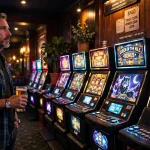
“Parlour pokies” can suggest a distinct room or a particular kind of machine. In casino settings, the phrase is better understood as referring to gaming machines on the casino floor; it does not, by itself, identify a separate venue category or guarantee a specific layout.
The national measure gives a clearer sense of scale. Across Australia, 3,308 gaming machines are both endorsed on venue licences and installed in casinos. That count combines two conditions: the machines must be covered by the relevant venue licence, and they must be installed. It is not a tally of every machine that might be discussed in advertising, nor a promise about what you will find at any one property.
For comparison, the total is more useful as a measure of the casino machine footprint than as a guide to an individual visit. It does not tell you how machines are distributed between venues, how many are available in a particular parlour, or what their operating arrangements are. Those details cannot be inferred from the national figure.
The word “parlour” may also make the setting sound like a separate, smaller gaming venue. The count concerns machines installed in casinos, not a complete inventory of every gaming venue in Australia. Keep the distinction clear: a casino machine total is not a national count of all pokies, and it is not a machine-by-machine directory.
If you are comparing physical venues, treat the figure as context, not a ranking. A larger national machine footprint does not establish that one venue is better for your needs. The relevant measure depends on what you are comparing—and this count only measures the licensed and installed casino-machine total.
A real-money offer may look like a direct route from a “pokies parlour” search to online play. That appearance tells you nothing about whether the service is authorised to operate for people in Australia. A page loading, accepting account activity or appearing at a different web address is not proof of Australian licensing.
The legal test is not whether a site looks established or uses familiar casino language. Under the Interactive Gambling Act 2001, operators cannot provide real-money online casino games to people physically located in Australia. That prohibition covers casino-style games such as slots, poker and table games. The Australian Communications and Media Authority (ACMA) is responsible for enforcing the Act and can investigate services that provide or advertise prohibited online gambling.
This distinction matters because a local licence for a physical gaming venue does not convert an online casino into an authorised Australian service. Nor does an offshore licence change the Australian rule. Account access is a technical fact, not a regulatory credential.
If you are assessing an online casino’s status, look for evidence that addresses the Australian law itself, rather than relying on a site’s own claims, account access or a familiar domain. For the governing framework, consult the Interactive Gambling Act 2001 and ACMA’s information at acma.gov.au. The relevant question is whether the operator may lawfully provide that real-money service to people in Australia—not whether the website is reachable.
The distinction is plain: an online casino-style service can be visible without being authorised for the Australian market. A working login does not settle the legal question.