
See how PayID transfers work and what to consider about deposits, bank limits, withdrawals, costs and bonus wagering terms.
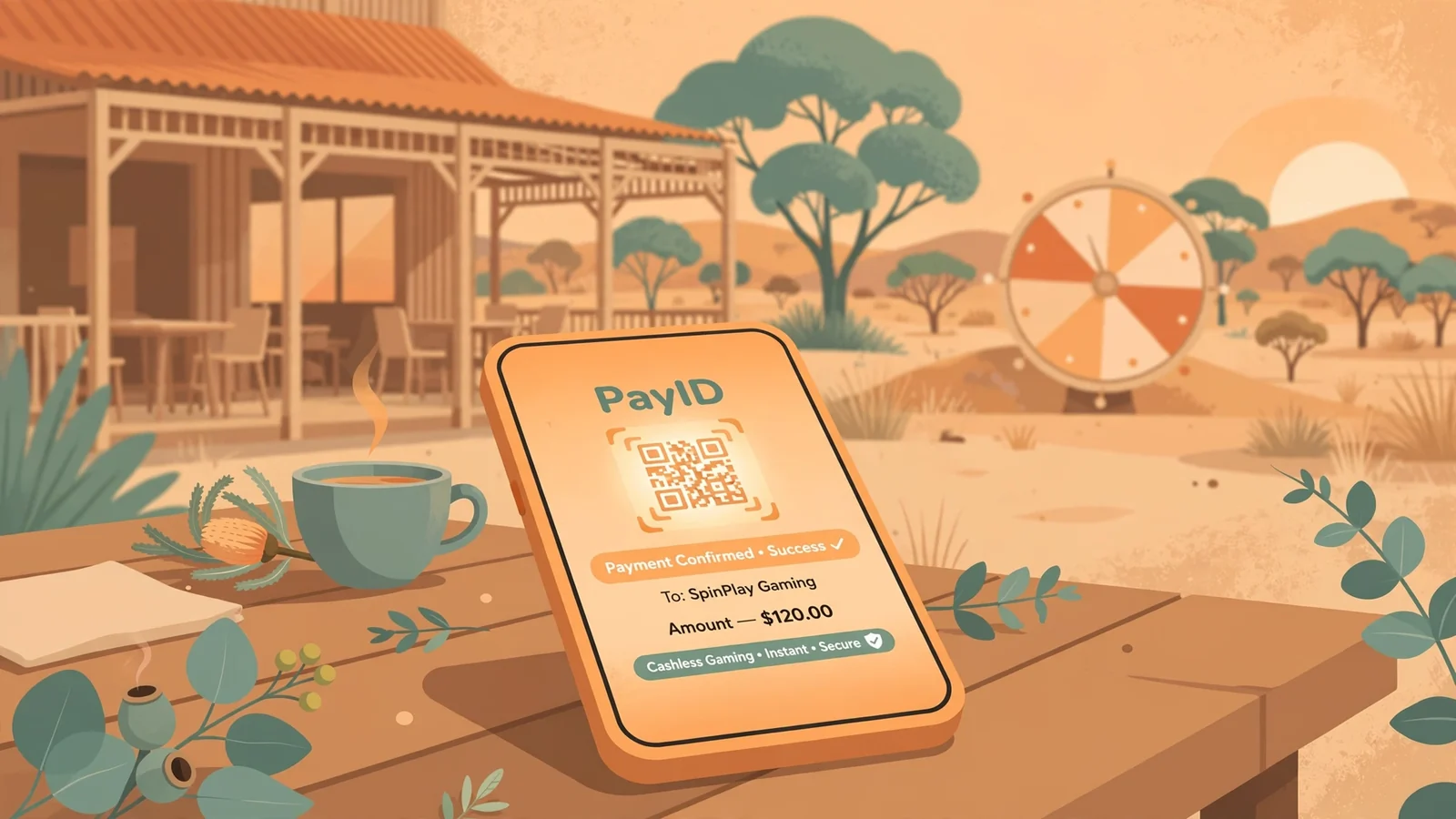
PayID is an Australian digital payment system built around an identifier, such as your mobile number or email address. Instead of relying on a recipient’s bank account details as the identifier you enter, a PayID transaction uses that recognised identifier to direct a transfer. PayID operates through the New Payments Platform (NPP), which enables quick transfers between banks.
That describes the payment layer, not the service receiving the money. PayID is not a pokies product, a casino account or a promise that a payment option will be available on a particular website. It is a way to identify the destination of a payment within Australia’s banking infrastructure. The distinction matters: a familiar payment method does not make every service that mentions it lawful or suitable for Australian residents.
A mobile number or email address is easier to recognise and enter than a long set of account details. In a PayID transfer, the identifier helps direct the money to its intended recipient through the participating banking system. The NPP is the infrastructure behind the transfer; PayID is the identifier-based system people use to address it.
Choosing a new PayID pokies site in Australia means checking the payment details that matter to you before you play. Use this list as a reference for the operator information available, and verify current payment options and terms directly with the site.
SpinsUp
SpinsUp is listed with a Curacao Gaming Control Board licence, number OGL/2023/174/0082, held by Dama N.V. Check the site's current PayID details before depositing.
LevelUp Casino
LevelUp Casino lists a Curacao eGaming licence, number OGL/2023/174/0082, held by Dama N.V., and a minimum deposit of A$15. Confirm whether PayID is available and check its terms before you deposit.
Rollero Casino
Rollero Casino lists a Curacao Gaming Control Board licence, number OGL/2023/176/0095, held by Hollycorn N.V. Check the site's current PayID details before depositing.
SkyCrown
SkyCrown lists a Tobique Gaming Commission licence and a minimum deposit of A$30. Its stated payout times are around 10–15 minutes for crypto and 1–5 days for fiat.
Wild Tokyo
Wild Tokyo lists a Curacao licence and a minimum deposit of A$10. Its stated payout times are 30–60 minutes for crypto and 1–5 days for fiat.
Kingmaker
Kingmaker lists a minimum deposit of A$30. Its stated payout times are around 90 minutes for crypto and 1–5 days for fiat.
MrPacho
MrPacho lists a minimum deposit of A$30. Its stated payout times are 30–120 minutes for crypto and 24–72 hours for fiat.
House of Pokies
House of Pokies lists an international iGaming licence, though the jurisdiction is not named. PayID payouts are stated as taking 1–24 hours; the minimum deposit is A$30, or A$10 when using PayID.
Uptown Pokies
Uptown Pokies lists a Curacao licence and has been operating since 2017. Its stated minimum deposit is A$20.
Golden Pokies
Golden Pokies lists a Curacao licence. Check the site's current PayID details and terms before depositing.
The practical idea is straightforward: you use an identifier rather than treating a bank account number as the main detail to type. That can make the payment route easier to follow, but it does not change the basic nature of the transaction. Money is still being transferred between bank accounts. PayID is not a wallet holding a separate balance, nor does the identifier itself represent funds.
PayID is designed for quick transactions between banks. Its role is therefore different from a card network or a stored-value account. The key point is not that one payment label guarantees a particular experience, but that PayID provides a recognisable route for transferring money through the NPP.
People may encounter phrases such as “PayID pokies” or “PayID payments” while reading about online gambling. Those phrases refer to a claimed payment route, not to a separate kind of game or a special PayID version of pokies. The payment system and the service accepting a payment are two different things.
That distinction is important in Australia. Under the Interactive Gambling Act 2001, operators cannot lawfully provide real-money online casino games to people physically located in Australia. The prohibition covers casino-style offerings such as pokies, poker and table games. A payment method’s presence in a description does not alter that rule, and it should not be read as an endorsement or indication that a real-money gambling service is lawful to use from Australia.
PayID itself is a general Australian payment system. Its existence does not establish that a particular merchant is authorised, that a transaction is permitted, or that a service will provide what it claims. Payment technology answers how money can be directed; it does not answer whether a business may offer a particular service to someone in Australia. Those are separate questions.
When considering any reference to PayID in a gambling context, keep three parts separate: the identifier, the banking infrastructure and the merchant. PayID supplies the identifier-based payment method. The NPP carries quick transfers between banks. A merchant is the party asking to receive or send money. Combining those parts in one sentence can make them sound like a single endorsed system. They are not.
This is also why a payment description cannot be treated as proof of a site’s status or conduct. PayID does not certify a merchant, assess the fairness of games, disclose game returns or guarantee that winnings will be paid. It has a payment function. Claims about a gambling service require a different assessment, and the Australian legal restriction remains relevant regardless of the payment method named.
The same care applies to wording such as “new PayID online pokies”. It may describe a new reference to PayID in gambling material, but it does not mean PayID has become a new form of online game or that the underlying legal position has changed. A payment method can be discussed independently of whether a merchant is permitted to offer real-money casino games to Australians.
If you see PayID mentioned alongside pokies, read the claim narrowly. It tells you that the page is referring to an identifier-based transfer system operating through the NPP. It does not, by itself, tell you who controls the receiving account, what protections apply to a particular transaction, or whether the service being promoted may legally be offered in Australia.
Legal Warning
Under the Interactive Gambling Act 2001, it is illegal for operators to provide real-money online casino games to people physically located in Australia.
The reliable distinction is simple: PayID is a payment mechanism, not a licence, a gaming product or a guarantee. Its identifiers make it possible to address a bank transfer using details such as a mobile number or email address, while the NPP provides the banking infrastructure for quick transfers. The legal status of an online gambling service is a separate matter.
Useful distinction.
In a payment flow that offers PayID, a deposit normally starts in the venue’s cashier: you select PayID, enter an amount, then use your banking service to authorise the transfer. The amount sent is the amount intended for the account balance; PayID itself does not add a transfer fee. A deposit may therefore be quick without being cost-free in every sense: the amount you choose, the venue’s minimum and any separate charge stated in its terms all affect what reaches your balance.
PayID deposits are typically completed within seconds. That describes the transfer, not every step around it. A cashier may still need to display the payment instructions, and the account balance may need to update after the transfer is made. If the payment does not appear promptly, check the transaction status and the venue’s payment instructions before trying again. Sending another payment while the first is unresolved could leave you with two transfers to reconcile.
Minimum deposits differ between operators. The commonly reported starting range is AU$10 to AU$20, so a deposit below that range may not be accepted by a particular cashier. A specialist review has reported that some operators accept deposits from AU$5; treat that as a venue-specific exception, not a standard amount available across PayID services.
The minimum is a payment condition, not a recommendation about how much to deposit. It tells you the smallest amount the cashier may accept, but it does not establish whether the service is lawful or whether a payment will be returned if a problem occurs. Those are separate questions. Keep the difference clear: a low minimum can make a payment technically possible, but it says nothing about the suitability of the transaction.
A displayed minimum also matters when you are comparing the amount you plan to send with the amount credited. If your intended deposit is below the stated threshold, the payment may not meet the venue’s conditions. If it is above the threshold, the balance still depends on the amount actually transferred and on any disclosed venue-specific terms. Read the displayed amount and the payment instructions carefully before confirming.
For Australian readers, there is a more basic constraint than the cashier’s minimum: the Interactive Gambling Act 2001 makes it illegal for operators to provide real-money online casino games, including pokies, to people physically located in Australia. A PayID option does not change that rule. Nor does its presence establish that an operator is authorised to provide the service, that games are fair, or that winnings will be paid. Payment access is not a licence.
PayID itself does not charge a transfer fee. Reputable venues also do not add a separate fee for PayID deposits or withdrawals. That distinction is useful when reading a cashier: a payment-system fee and a charge imposed by the venue are not the same thing. If the cashier or terms state that a deposit carries a charge, consider it separately from PayID’s own fee position rather than assuming the payment rail is responsible.
PayID itself does not charge a transfer fee, and reputable venues typically do not add separate fees for PayID deposits or withdrawals.
A no-fee transfer does not mean every aspect of an account is free of conditions. The venue may set a minimum, and its other account terms may affect how funds are treated. Check the amount to be debited and any charge shown before authorising a transfer. If the displayed total differs from the amount you intended to send, pause rather than confirming on the assumption that the difference is immaterial.
The useful comparison is therefore not simply “fast” against “slow.” For a deposit, the relevant columns are the minimum amount, whether any separate fee is stated, the amount you intend to send and the amount shown for confirmation. On the transfer-speed measure, PayID deposits are typically completed within seconds. On the cost measure, PayID itself adds no transfer fee. Those are distinct attributes; speed does not settle the question of cost or legality.
Read the cashier’s instructions and the terms associated with the payment option, then check that the amount shown is the amount you intend to authorise. A minimum may rule out a smaller deposit, while a separate venue charge, if stated, would affect the cost. Do not treat a payment method appearing on a page as evidence that the underlying gambling service is lawful in Australia.
If you are comparing PayID pokies offers, the payment details can look straightforward: a quick transfer, a stated minimum and no PayID transfer fee. But those details describe only the mechanics and price of the payment itself. They do not turn the service into a lawful one for people in Australia. A fast transaction is still just a fast transaction.
A PayID transfer has two separate risk points: whether your bank permits it and whether the payment details are correct. These are different from the time a deposit takes to appear. A transfer can be delayed or blocked before it is confirmed; once confirmed, it cannot be reversed through PayID.
A specialist review reports that the daily PayID limit is set by the customer’s bank, rather than being a universal PayID allowance. The amount available to you can therefore depend on your own banking arrangements. Check your bank’s current transfer limit and applicable terms directly with the bank; another customer’s limit is not a reliable guide to yours.
A daily limit is a control on transfers, not a guarantee that a payment will be accepted. A bank may apply additional checks or decline a transfer for reasons connected with its policies. If an attempted payment is stopped, do not assume that changing the amount or trying again will solve the issue. First establish whether the bank has rejected the transfer, placed it under review or allowed it to proceed. The status matters: sending a second payment while the first is unresolved can create a separate problem.
Some specialist reviews report that Australian banks, including some of the Big Four, have occasionally blocked PayID transfers to merchants identified as gambling-related under their acceptable use policies. That is a report of possible bank action, not a guarantee that a particular bank will block every such transaction. Policies and their application can change, and your bank is the relevant source for its current position.
Attention: Some Australian banks may block PayID transfers to merchants identified as gambling-related under their acceptable use policies.
A blocked payment is not the same as a failed PayID system. The bank may be applying its own rules to the recipient or transaction. Do not try to disguise the recipient or bypass a bank restriction. If your bank declines a payment, ask it what the status is and what options its policies allow. This keeps the decision with the institution responsible for the account.
The PayID details used for a transaction must match the PayID registered with your bank. This is a practical identity check, not a cosmetic preference. If the details differ, a payment may not be accepted or may require attention before the mismatch is resolved. Confirm the registered PayID in your banking service rather than relying on a remembered email address or mobile number.
Keep account ownership consistent as well. The bank account name should match the name on the relevant profile. A mismatch can create difficulties when funds are being checked or returned, and it may take additional communication to establish who controls the account. Do not use another person’s PayID or banking details to get around a mismatch. That can make it harder to show that the payment belongs to you.
Before confirming any transfer, review the recipient information and the amount displayed in your banking service. A correct identifier matters because PayID uses an identifier to direct the payment. If you are uncertain that the recipient is the intended one, stop and verify it before authorising the transaction. A familiar payment method does not make an unfamiliar recipient safe.
PayID transactions are irreversible once confirmed. Treat the confirmation step as final: check the recipient details and amount before authorising the payment, not after. If you notice a mistake before confirmation, do not proceed. If a transfer has already been confirmed, contact your bank promptly and explain what happened. The bank may be able to advise you, but the transfer cannot simply be cancelled through PayID.
This distinction is important when a payment appears to be taking longer than expected. An unconfirmed or declined transfer and a confirmed transfer are not equivalent. Check the transaction status in your banking service and avoid sending another payment until you understand what happened to the first one. A second attempt does not undo an earlier confirmed transfer.
There is also a legal context specific to Australia. The Interactive Gambling Act 2001 prohibits operators from providing real-money online casino games, including pokies, to people physically located in Australia. That prohibition applies to the service provider; it does not make PayID a sign that a gambling service is lawful or endorsed by a bank. A payment option is only a payment mechanism. It says nothing about the legality of the recipient’s service, the fairness of a game or whether a consumer will receive funds from an operator.
For a reader assessing a payment record or a bank notification, keep the key checks in order: identify whether the transfer was confirmed, verify the PayID details against the bank registration, and ask the bank about its own limit or decision. Do not treat a completed transfer as reversible, or a bank’s acceptance of one payment as approval of the underlying activity. The bank’s transfer controls and the legal status of an online service are separate matters.
A PayID withdrawal has two separate stages: the casino’s handling of the request and the transfer from its system to your bank account. PayID can move money quickly once a payment is sent, but that does not mean a withdrawal request is paid as soon as you submit it. The casino’s review comes first, and its timing can shape the total wait.
After you submit a withdrawal request, the casino reviews it internally. This is distinct from the bank transfer itself: while the request is being checked, the money has not yet left the casino’s system through PayID.
A specialist review describes payout speed as depending on the casino’s review process and the player’s know-your-customer (KYC) status. KYC checks concern identity verification. If verification is incomplete or further checks are needed, the request may not move to payment until those steps are resolved. The precise checks and process can differ, so the relevant terms are those stated by the service handling the request.
For you, the useful distinction is between a request that is still under review and one that has been approved. A pending label may refer to the casino’s internal handling, not to a delay at your bank. Treating those stages as one process can make a transfer seem overdue before it has actually been sent.
Some specialist reviews report that a casino-initiated PayID withdrawal can remain pending for 24–72 hours before the funds leave the casino’s system. This is a reported possibility, not a fixed rule for every venue or request. The length of any internal hold depends on the operator’s process and the circumstances of the account.
That period should not be confused with the time taken by PayID after the casino releases the money. A transfer can be quick once initiated, while the earlier review or pending stage takes longer. In other words, the payment network cannot speed up a request that has not yet been approved and sent.
Check the withdrawal status and any messages in your account for an indication of which stage applies. If the status is unclear, ask the service’s support team whether the request is still being reviewed or has been released for payment. That is a more useful distinction than relying on a single elapsed-time estimate.
Withdrawal Process
Internal Review
The casino reviews your request and verifies your identity via KYC checks.
Pending Period
The request may remain pending for 24–72 hours before funds leave the casino's system.
Transfer Initiation
Once approved, the casino initiates the PayID transfer to your bank account.
Fund Arrival
Funds typically reach the account within the same day or 12–24 hours after approval.
Once approved, the casino initiates the PayID transfer. PayID supports withdrawals as well as deposits, and money can move quickly in both directions. Specialist reviews describe approved PayID withdrawals as taking 12–24 hours to arrive, while also reporting that, after approval, funds may reach an account within the same day. These are reported timeframes, not a promise for an individual payment.
The time from submission to arrival can therefore include both the casino’s internal handling and the transfer after release. A specialist review gives a total request-to-receipt estimate of 2–4 days where an internal pending period applies. That overall estimate is not the same as the transfer time after approval: it includes the earlier wait.
Keep the stages separate when checking progress:
| Status | What it means |
|---|---|
| Submitted or pending | The casino has received the request; it may still be reviewing it. |
| Approved or released | The casino has authorised and initiated the transfer. |
| Received | The funds have appeared in the account linked to the PayID. |
The labels shown on a cashier page may differ, but the practical question remains whether the payment has left the casino’s system.
Before a request is processed, check that the PayID details you provide correspond to the PayID registered with your bank. The account name should also match the name on your casino profile. A mismatch can complicate verification or prevent the withdrawal from being completed as expected.
If you are unsure which PayID is registered to your account, confirm it with your bank before submitting a request. Do not assume that an email address or mobile number is linked to the intended account simply because you use it elsewhere. The destination needs to be the one associated with your bank account.
PayID transactions are irreversible once confirmed. That makes checking the recipient details before payment is released important; an incorrect destination is not a detail to sort out after the transfer has been sent.
Start by checking the request status. If it remains pending, ask whether the casino has completed its review and what, if anything, is still required. If it is marked approved or released, confirm the destination PayID and account details, then ask the casino for confirmation that the transfer was initiated. You can contact your bank if the sender confirms release but the funds do not appear.
Keep the request confirmation and any messages about the payment. They help distinguish an internal hold from a transfer that has already been sent. A fast payment method does not remove the review stage. That distinction matters.
A PayID withdrawal comparison is only useful when it separates the transfer itself from the operator’s handling of the request. The payment method may move funds quickly once a transaction is released, but review steps and venue-specific terms can affect both the time you wait and the amount that reaches your account. There is no single option that wins on every measure.
There is also an important legal boundary: under Australia’s Interactive Gambling Act 2001, operators cannot provide real-money online casino games to people physically in Australia. The comparison criteria below are informational; PayID availability does not establish that a service is lawful, licensed, fair or willing to pay winnings.
Start by identifying when the operator’s clock begins. A stated transfer time may describe only the period after approval, while a separate pending or review stage comes first. If those stages are blended into one claim, it is difficult to tell whether the estimate covers the full wait from request to receipt.
A specialist review describes operator pending periods of 0–12 hours, with manual checks taking 12–24 hours or longer over weekends. The same kind of review reports that a first withdrawal or an account selected for additional checks can take 24–48 hours at the slower end. These are reported ranges, not fixed service standards: processing varies by operator and circumstance.
One specialist review’s own testing recorded outcomes from around five minutes to 24 hours, with the result varying by venue and the time the request was made. That range should be read as an account of those tests, not a promise about what another operator will do. A fast result in one test does not establish a reliable time for later withdrawals.
For a useful comparison, look for separate statements about request review, approval and transfer to the bank account. If an operator gives only a broad “fast payout” description, it does not tell you how much of the wait happens before PayID is used. Dry, but important.
A withdrawal minimum determines how much must be available before a request can be made. The commonly reported PayID minimum is AUD 20–50, but the relevant threshold is the one stated in the applicable terms. A low minimum may matter if you want to withdraw a smaller balance; it does not, by itself, indicate a lower fee or faster processing.
Check whether the minimum applies to every withdrawal or whether a different rule affects smaller requests. A specialist review reports that some operators deduct A$5–A$10 from withdrawals below internal thresholds, with A$100 or A$200 cited as examples of those thresholds. Because such terms may change, compare the current written conditions rather than assuming that a minimum withdrawal is the only amount-related rule.
Fees need their own column. PayID itself does not charge transfer fees, and reputable venues do not add a PayID fee for deposits or withdrawals. However, a specialist review reports that some casinos charge AUD 2–5 per withdrawal. That is an operator charge, not a PayID transfer fee. Check whether the terms describe a flat deduction, a charge tied to the withdrawal, or a deduction that applies only in certain circumstances.
Before treating one set of terms as more favourable, compare like with like:
| Criterion | What to establish |
|---|---|
| Minimum withdrawal | The smallest amount the terms allow you to request |
| Withdrawal charge | Whether an operator fee applies and how it is calculated |
| Small-withdrawal deduction | Whether a deduction is triggered below an internal threshold |
| Review period | Whether the operator states a pending or manual-review stage |
| Transfer timing | How long is stated to elapse after approval |
| Conditions | Whether additional checks or account status can affect processing |
This layout helps distinguish low cost from speed. An option with no stated withdrawal fee may still involve a longer review; a short transfer estimate may exclude the time before approval. If a term is unclear, it cannot be counted as a confirmed advantage.
Your comparison depends on what you are measuring. For cost, focus on the minimum, any flat withdrawal charge and possible deductions below a threshold. For timing, distinguish the operator’s review from the PayID transfer after approval. For predictability, favour terms that explain both stages and the circumstances that can delay them—without treating any reported estimate as a guarantee.
Do not infer legitimacy or payment reliability from the presence of PayID. A payment method describes a way of moving money; it does not verify the legal status of the service or settle whether a withdrawal will be approved. In Australia, that distinction matters more than a tidy comparison table.
Before considering any real-money offer, note the Australian legal position: under the Interactive Gambling Act 2001, providing online casino games, including pokies, to people in Australia is illegal for operators. The financial terms described below are general information, not an invitation to use such a service.
Deposit minimums typically range from AUD 10–30, while withdrawal minimums are commonly between AUD 20–50.
A specialist review reports PayID deposit minimums in the AUD 10–20 range, while another review describes minimums spanning AUD 10–30. These are reported terms, not fixed standards: an operator can set a different threshold, and its rules may change. Treat the cashier’s displayed minimum as a term to verify, not as a guarantee that a payment method or service is legally available to you.
A low minimum tells you only how little an operator may accept for a deposit. It says nothing about the total cost of participating, the likelihood of receiving a withdrawal, or whether a service is lawful to provide in Australia. Do not infer that PayID acceptance signals licensing, fairness or willingness to pay winnings.
Withdrawal thresholds can also affect the balance you can request. Specialist reviews describe minimum withdrawal amounts of AUD 20–50. If a balance is below the stated threshold, you may be unable to request a payout until it reaches the required amount, subject to the operator’s terms. Read the rules for deposits and withdrawals separately: an entry minimum does not establish a matching withdrawal minimum.
For an ordinary payment decision, the comparison is straightforward: the deposit minimum is the amount required to fund an account, while the withdrawal minimum is the amount that must be available before a payout request can be submitted. The two figures can differ. A small deposit threshold therefore does not necessarily mean that a small remaining balance can be withdrawn.
A bonus may come with a wagering requirement: a condition that requires a stated amount of play before the bonus, or winnings connected to it, can be withdrawn. Specialist reviews report requirements of 30x–45x the bonus amount. The multiplier is applied to the amount specified in the offer’s terms, so check whether the calculation uses the bonus alone or another defined amount. Do not assume the wording is identical across offers.
The multiplier is only one part of the condition. Read the full bonus rules to identify which activity counts towards wagering and what restrictions apply to play while a bonus is active. The rules determine whether a balance is withdrawable; the headline bonus amount does not. If the calculation or eligible activity is unclear, do not treat the offer as cash available for withdrawal.
Pay particular attention to any maximum-bet condition during wagering. Exceeding the applicable maximum bet can void the bonus and associated winnings. The relevant limit is the one in the offer’s terms, not an amount you can safely infer from the bonus headline. A bonus can therefore make a balance more conditional, not more certain.
If reviewing a cashier page, confirm whether PayID is listed and read the applicable deposit and withdrawal conditions before creating an account. Also check that the bank account name matches the casino profile name; mismatched details can cause withdrawal problems. These checks do not establish that the operator is authorised to provide online casino services in Australia.
Avoid creating multiple accounts at the same casino. An operator may treat this as a breach of its rules, potentially leading to account bans or forfeiture of winnings. The exact consequences depend on the terms, so do not assume that opening another account will preserve access to a balance or bonus.
A useful way to assess the financial terms is to separate three questions: what amount is required to deposit, what balance is required to request a withdrawal, and what conditions attach to any bonus. A small entry figure answers only the first. A wagering multiplier and its restrictions determine whether bonus-related funds can become withdrawable, while the withdrawal threshold sets a separate gate.
For Australian readers, that distinction sits alongside the legal framework: the law prohibits operators from providing real-money online casino games to people physically in Australia. A payment option, minimum amount or bonus condition does not change that position. Clear terms are not a licence.
PayID itself does not charge a transfer fee. A venue may still apply its own withdrawal fee or other charge, so check its terms before sending or withdrawing money.
If the cashier offers PayID, select it, enter your deposit amount and authorise the transfer through your banking service. Make sure the PayID details match the PayID registered with your bank.
After the casino approves a cashout, the transfer usually reaches your account within the same day. Casino review and any pending period can make the total time from request to receipt around 2–4 days.
PayID transfers typically take 12–24 hours after approval, though they usually arrive within the same day. A casino’s review or pending period can extend the full wait to around 2–4 days.
Some sites targeting Australian players accept PayID deposits. However, operators cannot lawfully provide real-money online casino games to people physically located in Australia.
Some gambling sites may advertise PayID withdrawals, but operators cannot lawfully provide real-money online casino games to people physically located in Australia.
PayID deposits typically complete within seconds. The casino balance may take additional time to update after the transfer.
Typical minimum deposits are A$10–A$20, although some operators accept deposits from A$5.