Mobile access, payment steps and casino terms are separate considerations when using e-wallets for real-money pokies.
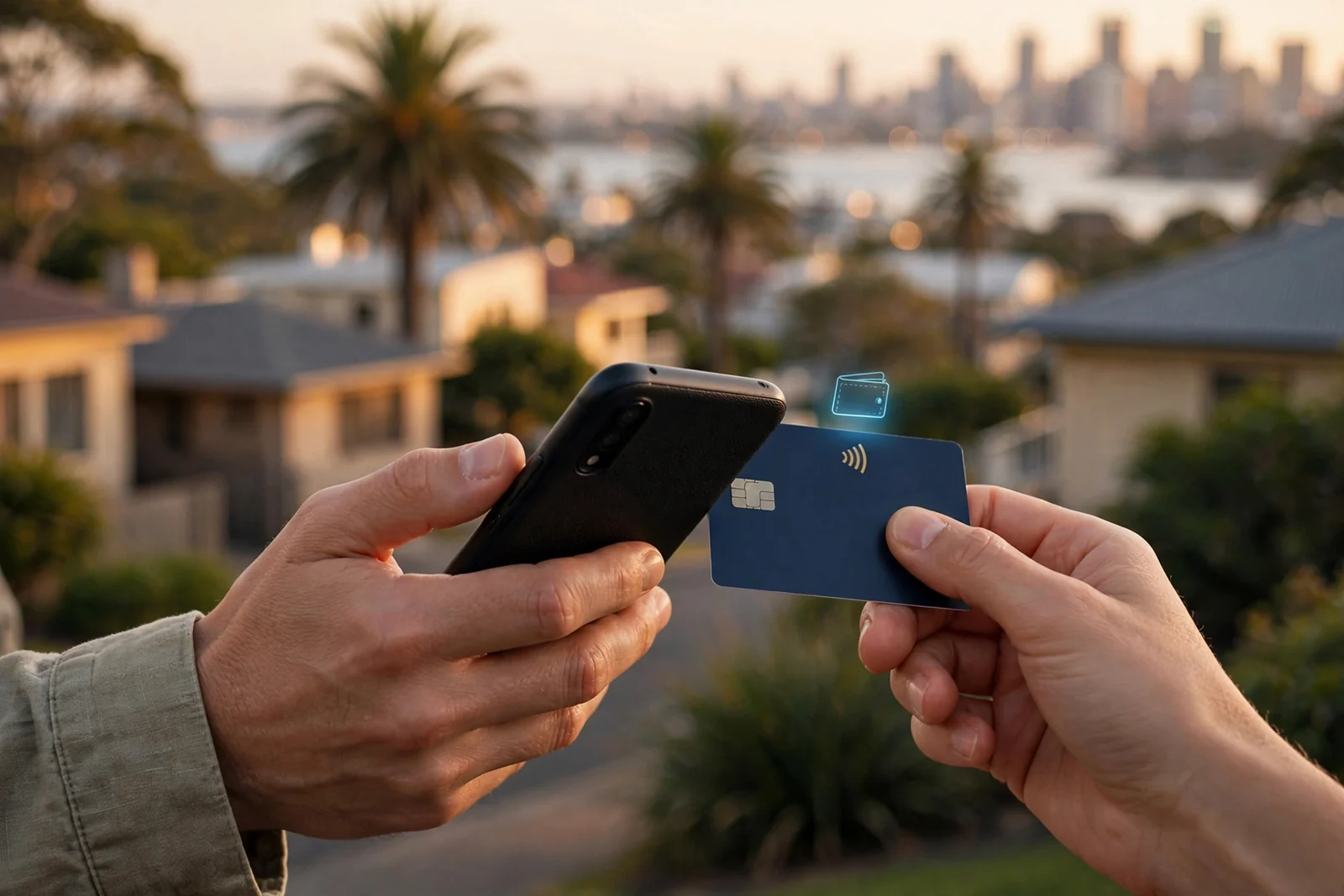
On a phone, the key distinction is how you open a casino website—not whether you use an e-wallet. A mobile browser, a Progressive Web App (PWA), a native app and a social casino app are different ways to access services. An e-wallet is a payment method, so it does not determine which access format appears on your screen.
For real-money casino services that accept Australian users, browser access and PWAs are more typical than native mobile apps. In practice, that means you can open the casino website in your phone’s browser and use the same account you use on desktop. You do not need a separate mobile account simply because you have switched devices.
Browser play means visiting a casino website through the browser already on your phone. The site opens as a web page rather than as an app downloaded from an app store. You sign in to your existing account there, just as you would on a desktop.
When choosing an online pokies site that accepts e-wallet payments in Australia, check the available licensing and payment details before deciding where to play. This list gives you a concise reference to the facts provided for each operator.
SpinsUp
SpinsUp is listed with a Curacao Gaming Control Board licence, OGL/2023/174/0082, held by Dama N.V.
LevelUp Casino
LevelUp Casino lists a Curacao eGaming licence, OGL/2023/174/0082, held by Dama N.V. Its minimum deposit is A$15.
Rollero Casino
Rollero Casino lists a Curacao Gaming Control Board licence, OGL/2023/176/0095, held by Hollycorn N.V.
SkyCrown
SkyCrown lists a Tobique Gaming Commission licence. You can note its stated payout speeds: around 10–15 minutes for crypto and 1–5 days for fiat; the minimum deposit is A$30.
Wild Tokyo
Wild Tokyo lists a Curacao licence and a minimum deposit of A$10. Its stated payout speeds are 30–60 minutes for crypto and 1–5 days for fiat.
Kingmaker
Kingmaker lists payout speeds of around 90 minutes for crypto and 1–5 days for fiat, with a minimum deposit of A$30.
MrPacho
MrPacho lists payout speeds of 30–120 minutes for crypto and 24–72 hours for fiat. Its minimum deposit is A$30.
House of Pokies
House of Pokies lists an international iGaming licence, but the source does not name the jurisdiction. PayID payouts are stated as taking 1–24 hours; the minimum deposit is A$30, or A$10 when using PayID.
Uptown Pokies
Uptown Pokies lists a Curacao licence and is stated to have operated since 2017. Its minimum deposit is A$20.
Golden Pokies
Golden Pokies lists a Curacao licence; no other operator details are provided here.
That distinction helps when you are looking for e-wallet pokies on a mobile device. The phrase can make it sound as though an e-wallet comes with its own casino app, but the wallet and the casino’s mobile access are separate. You may reach the casino through its website; payment options are handled within the service. The access format does not, by itself, tell you which payment methods are available.
Casino apps are not commonly found in the Australian versions of Google Play or the Apple App Store. As a result, checking those stores is not a reliable way to find the usual mobile route to a real-money casino. Browser access is the more familiar option.
A Progressive Web App, or PWA, is still tied to the casino website. It can behave like a native app on your phone, but it is essentially a shortcut to the site rather than a separate app obtained from an app store.
If the website offers a PWA, the installation prompt may invite you to add it to your home screen. You tap the install or add-to-home-screen option and confirm. The shortcut then gives you a direct way to open the website from your device. It does not turn the service into a different casino or create a separate account.
The practical comparison is straightforward: a browser route opens from the browser, while a PWA gives you a home-screen shortcut to the website. Both are ways of reaching the web service. Neither should be confused with a native app distributed through an app store.
A native app is software distributed as an app for a mobile operating system. For casino services that accept Australians, this is less common than browser or PWA access, and such apps are rarely listed on the main app stores in Australia. So if you cannot find a real-money casino app there, that does not mean the website has no mobile access; the browser may be the intended route.
Social and free-play casino apps are a separate category. These use virtual credits rather than real-money gambling, and they are legal to use in Australia. They can be downloaded directly from Google Play or the Apple App Store. Their presence in an app store does not make them equivalent to a real-money casino service: the credits and purpose are different.
That is the useful dividing line when comparing mobile options. Browser play and PWAs provide ways to reach a casino website; a native app is a separately distributed application; and a social app uses virtual credits. Similar graphics or familiar casino terminology do not erase those differences.
The real-money casino services discussed in this context are offshore and crypto-friendly; this description of mobile formats is not a recommendation to use them. A mobile shortcut changes how a website opens, not what kind of service it is. If you are comparing e-wallet access on a phone, first identify whether you are looking at a website, a PWA shortcut or a virtual-credit app. That is a clearer starting point than assuming every casino icon represents the same thing.
In short: browser first, PWA where offered.
An e-wallet can sit between your casino balance and your own account, but it does not remove the casino’s withdrawal checks. The transaction has several distinct stages: you request a cash-out, the operator may hold it as pending, the request is reviewed, and the approved amount is sent to the payment method. “Submitted” and “received” are not the same status.
A pending period is the time a casino keeps a withdrawal request in its own system before processing it. It may use that time for account or transaction checks, and the request may remain cancellable while pending. Once processing begins, the payment provider still has to deliver the funds. Check the cashier and payment terms for the length of the pending period and whether the clock starts when you request a withdrawal or when the operator approves it.
A specialist review reports that e-wallet withdrawals may arrive within 24 hours after the casino’s pending period ends. Treat that as a reported timing, not a promise: the casino’s review, provider handling and any account checks can affect the result. A separate specialist review describes crypto and e-wallet withdrawals as being processed in under 24 hours, but “processed” may refer to the operator sending the payment, rather than the funds appearing in your wallet. Read the wording carefully. Processing is not the same as arrival.
If a request takes longer than the stated window, check its status before submitting another one. A second request could complicate the account record or create confusion about which payment is being reviewed. If the casino shows the withdrawal as approved but the wallet has not updated, contact the operator with the transaction details and ask whether the payment has been released.
Expect the first cash-out to involve identity checks. Casinos commonly request KYC documents, which can include a government-issued ID or selfie and proof of address. The purpose is to match the person using the account with the account details and to confirm the withdrawal request. A document that is unreadable, expired or inconsistent with your registration information can delay review.
It is sensible to check the verification requirements before depositing, rather than waiting until a balance is ready to withdraw. Use your own account details and make sure they match the information supplied during registration. If the operator asks for additional documents, follow its secure upload process and keep a record of what was requested and submitted. Do not send sensitive identity documents through an unverified contact channel.
Completing verification does not guarantee that a withdrawal will be approved; it means the operator can assess the request against its procedures. For an offshore crypto-friendly casino, confirm that the site accepts your location before depositing. If an offshore casino refuses to pay, there is no Australian government body to complain to for recovery of the winnings. A punter has little practical leverage once a payment dispute is left to the operator’s process.
Attention: If an offshore casino refuses to pay, there is no Australian government body to complain to for recovery of the winnings.
Do not assume that a method shown for deposits is also available for withdrawals. A specialist review reports that some casinos require you to withdraw through the same method used to deposit, while other methods are deposit-only. This can matter if you choose an e-wallet for a deposit but the cashier’s withdrawal rules require a different route or additional steps.
Before funding an account, look for the casino’s rules on eligible cash-out methods, method matching and any limits that apply to each route. Check whether the name on the e-wallet account must match the casino account, and whether the operator permits withdrawals to that wallet at all. These are account-rule questions, not details that can be inferred from a payment logo on the cashier page.
If the original deposit method cannot receive a withdrawal, the operator’s terms should explain what alternative is available. Ask the operator to clarify the process before depositing if the wording is unclear. A method that is easy to use for a deposit may be less useful if it cannot carry the withdrawal back.
Some casinos set weekly or monthly withdrawal ceilings. A specialist review reports weekly limits in the range of $4,000–$10,000 at some casinos; that is an operator-specific claim, not a universal rule. Find the current limit in the cashier or terms, and check whether it applies per account, payment method or time period. If a balance exceeds a cap, payment may be split or delayed under the operator’s rules.
Keep a simple record of deposits, withdrawal requests, approval notices and payment confirmations. It gives you a clear timeline if you need to ask about a pending request. Also review the available deposit, loss, wager and session-time controls before playing; responsible-gambling tools are useful only if you know where to find them.
A smooth login does not settle the harder question: whether the account is verified and the withdrawal route is permitted. Check those rules first. A payment button is not a payout policy.
MiFinity, Skrill and Neteller are e-wallet names you may encounter when researching offshore casino payment options. They are commonly used for both deposits and withdrawals, but that does not mean every site supports all three, or that any one is automatically the right fit for you. Treat them as separate payment choices to check, not as a ranking.
The useful comparison is practical: does the specific site list the wallet for the transaction you want to make, and can you use it under the wallet provider’s own rules? A name appearing in a general payment guide is not confirmation that it is available at a particular cashier. Check the site’s current payment information before opening an account or moving money.
MiFinity is one of the e-wallets commonly used for deposits and withdrawals. If you are considering it, verify that the site lists MiFinity as an available method and check the wallet’s own terms. The same test applies to Skrill and Neteller. Their shared category does not make their account conditions interchangeable.
Skrill is another familiar name in this group. Its presence in a payment menu tells you that the site presents it as an option; it does not establish that your account is eligible or that every transaction type is supported. Confirm the conditions with both the site and Skrill rather than relying on a logo or a third-party summary.
Verify that the site lists it as an available method and check the provider's own terms.
Confirm eligibility and whether every transaction type is supported with both the site and Skrill.
Check current cashier information and relevant Neteller terms before deciding if it suits your needs.
Neteller is also commonly used for both sides of casino transactions. As with the other two, treat availability as specific to the site and the account, not as a blanket promise. Check the current cashier information and the relevant Neteller terms before deciding whether it suits your needs.
No provider wins on name recognition alone. The better fit depends on the method you can actually use, the rules attached to your account and the site’s stated support for that method. A tidy comparison beats a confident guess.
| Check | What to confirm |
|---|---|
| Availability | Is MiFinity, Skrill or Neteller listed by the specific site? |
| Transaction type | Does the listing cover the transaction you intend to make? |
| Provider conditions | Do the wallet’s own terms allow the intended use? |
| Site conditions | Are there site-specific rules attached to that method? |
| Account details | Do the account requirements fit your circumstances? |
This table is a way to organise your checks, not a claim that the providers have identical features or conditions. If a detail is unclear, ask the provider or site directly and keep the answer. A payment method is only useful when its actual terms are clear to you.
A site may display several wallet names, but that does not establish that each one is available to every customer or for every purpose. Nor does the fact that a wallet is commonly used for deposits and withdrawals guarantee that a particular site supports both directions. Confirm the specific option rather than inferring it from the provider’s reputation.
Be cautious with old payment pages, copied lists and promotional banners. They may name a provider without showing whether the option remains available or what conditions apply. Use the current information provided by the wallet and the site. If their statements differ, resolve the discrepancy before proceeding.
These names identify payment providers, not endorsements of any casino. MiFinity, Skrill and Neteller are simply the three e-wallets commonly encountered for both deposits and withdrawals. Which, if any, is suitable depends on the terms you verify for your own situation. No universal winner.
For an Australian punter comparing mobile deposit routes, the useful distinction is not simply “fast” versus “slow”. It is whether the method is available on the payment page, how quickly the transaction is credited, whether a fee applies, and whether the bank allows the payment. Those details can differ between operators and payment methods, so an option named in a general list is not necessarily available for every account.
A specialist casino review describes PayID deposits as near-instant and typically free. Treat that as a reported feature, not a guarantee for every payment. The operator’s cashier should show whether PayID is currently offered and any fee or processing information before you confirm. If speed and avoiding an extra charge are your main criteria, those are the details to compare. A deposit still depends on the payment being accepted and correctly completed.
Other routes may include BPAY, cards and cryptocurrency. A specialist review also lists POLi, but that does not make it a current local option: POLi ended its Australian operations in September 2023 and no longer processes Australian transactions. If a payment page still displays its name, do not assume the service can complete a local transfer. An old logo is not a working payment rail.
| Method | What to check before paying |
|---|---|
| PayID | Whether the cashier offers it, the stated processing time and any fee |
| BPAY | The processing information shown for that specific transaction |
| Card | Whether your bank permits gambling-related charges and whether the payment is flagged |
| Cryptocurrency | The method’s stated processing details and any requirements shown by the cashier |
| POLi | It no longer processes Australian local transactions |
The payment methods listed for mobile casino deposits include PayID, BPAY, cards and cryptocurrency, with processing times that vary. A specialist review is the basis for that list, so treat it as an indication of routes a punter may encounter rather than a promise that a particular cashier will offer them. Check the actual deposit screen before choosing. The route that looks simplest on a general page may not appear when you sign in.
A displayed processing estimate also should not be mistaken for a guaranteed credit time. Follow the payment instructions shown at the point of deposit and check the account balance before trying again. Repeating a transaction because the first one has not appeared may leave you unsure whether one or both payments went through. If a payment is pending or fails, the cashier or payment provider is the relevant place to check its status.
Some Australian banks flag or block gambling-related card charges, according to a specialist review. That can cause a deposit to fail even when the card details are correct. A decline is therefore not proof that you entered the wrong information, nor does it establish that every card from that bank will be treated the same way. The bank’s own rules and the transaction’s classification can affect the outcome.
If a card payment does not go through, check the bank’s response and the cashier’s status before attempting it again. Do not keep resubmitting a charge that the bank has rejected. If you compare another method, check its availability and processing details on the payment page rather than assuming it will work in the same way as a card.
The deciding criterion depends on what matters to you. PayID has the clearest reported combination of speed and fee information; BPAY, cards and cryptocurrency require you to check the details presented for the specific transaction. POLi is not a usable local route. No payment label removes the need to verify that the method is offered and that your payment has completed.
These payment options relate to offshore crypto-friendly casinos, not locally authorised online casino services. Before depositing, confirm that the site accepts your location. A payment route appearing in a cashier does not establish that the service is lawful for an operator to provide in Australia, or that access and payment will be available to you. Be careful with payment decisions.
When you encounter a new pokies site on your phone, check how it behaves before treating it as a practical option. A polished home page is not a useful test by itself. The important criteria are whether the site loads reliably in your browser, whether its controls work on a small screen, and whether your device can keep the session responsive.
Browser access is the common arrangement for Australian mobile casinos. You can generally use the same account on a phone as on a desktop, rather than setting up a separate mobile profile. Start by opening the site in your usual mobile browser and checking the page layout, menus and game controls. Text should remain readable, buttons should be easy to select, and important account pages should fit the screen without forcing you to navigate a desktop-style layout.
A new e-wallet pokies site may describe its mobile access in confident terms, but the browser itself is a simple first check: does the site open, stay connected and respond to ordinary taps on your device? If the page repeatedly reloads, controls stop responding or the layout becomes difficult to use, that is a practical drawback. It is not evidence that a different app will necessarily solve the problem.
Mobile trouble can come from the connection or the phone, not just the website. Specialist mobile-casino reviews identify weak connections, limited available memory, outdated browsers and a crowded set of background apps as common causes of problems. That gives you a useful diagnostic order: check your connection, close apps you are not using, make sure the browser is current, then reload the page.
If the site works better after those checks, the original issue may have been device performance rather than the site’s mobile design. If it still behaves poorly, avoid repeatedly refreshing or opening multiple sessions; that can make it harder to tell whether the fault is temporary or consistent. Try the browser again later or on another connection you control. The comparison is useful because it changes one condition at a time, rather than guessing.
Available memory matters because a phone has to manage the browser alongside whatever else is running. If several apps are active, closing those you do not need may free resources. A browser update can also address compatibility problems, while a more stable connection can reduce interruptions. These steps cannot guarantee that a site will run smoothly, but they help separate a device-side problem from a site-side one.
A site may invite you to install an app outside the official app stores. That is different from simply opening its mobile website. Sideloaded casino apps carry security risks, and their safety depends on the operator. An installation prompt is not, by itself, proof that an app is secure or that it will perform better than browser access.
Before installing anything, consider whether the browser already provides the access you need. Check who operates the site, what permissions the app requests, and whether you can understand how it will handle information on your device. Do not proceed if the download source or the app’s purpose is unclear. Removing an app later does not undo information already shared with it.
For a first visit, the browser is the more straightforward way to assess the mobile setup: you can see whether the site works without first adding software to your phone. If you choose to consider a sideloaded app, weigh its possible convenience against the security uncertainty. A smoother-looking icon is not a security check.
A mobile test can tell you about layout and performance; it cannot settle whether a site may accept you or what protections apply. Offshore crypto-friendly casinos are not Australian-licensed casino services. Before depositing, confirm directly with the site that it accepts customers from your location. Do not use a VPN to get around a block or location restriction: doing so may void winnings or lead to account closure.
If an offshore casino refuses to pay, there is no Australian government body to complain to for payment recovery. That limitation matters before you decide whether to use a site, not after a dispute begins. Keep the mobile check separate from that decision: a site can load cleanly on your phone and still leave you with substantial legal and payment risks.
The practical comparison is therefore straightforward. Browser access avoids the extra security question raised by a sideloaded app; good connection and device conditions help you judge performance fairly; and a responsive layout is more useful than claims about mobile convenience. None of these checks turns a site into a safe or lawful Australian casino service. A working page is only a working page.
The legal distinction in Australia is between the operator and the punter. Under the Interactive Gambling Act 2001, it is unlawful for an operator to provide online casino-style games to people in Australia. That restriction covers services offering games such as pokies, poker, blackjack and roulette. The Act does not make it illegal for an individual Australian to play at an offshore mobile casino.
That difference does not make access straightforward or remove the risks. The Australian Communications and Media Authority (ACMA) works to restrict access to gambling services that breach the rules, including by blocking websites. A page loading successfully today is not proof that access will continue, or that a service is authorised to operate in Australia. A block can interrupt access without resolving any dispute you have with an operator.
Operators that accept Australian customers may identify a licensing jurisdiction such as Curaçao, Malta, or Gibraltar. The Malta Gaming Authority is also commonly referred to as the MGA. These are offshore jurisdictions, not Australian licences. A licence from one of them does not override Australia’s restriction on operators providing online casino games to people located here, nor does it turn an offshore service into an Australian-regulated one.
Legal Risk
Under the Interactive Gambling Act 2001, it is unlawful for an operator to provide online casino-style games to people in Australia.
Treat the licence information as one part of your risk assessment, not as a guarantee of local protection. The key distinction is who issued the licence and where the operator is based. If an offshore crypto-friendly casino is being considered, confirm directly with the operator that it accepts customers in your location before making a deposit. Do not assume that a payment option, including an e-wallet, means your account is eligible or that a withdrawal will be available.
A VPN can make your apparent location differ from your actual one, but it does not change the legal status of the operator or create a right to use its service. Casinos may treat VPN access as a breach of their terms. That can mean winnings are voided or an account is closed. If the site’s rules prohibit access from your location, trying to bypass a block may leave you with fewer options, not more.
Payment is a separate practical risk. An offshore operator may accept a deposit and still apply its own account, location or withdrawal rules later. Read those rules before sending funds, and keep a record of the terms shown to you. Do not infer that because a deposit has gone through, the operator will necessarily release winnings on the same basis. With an offshore service, the payment relationship is governed by the operator’s terms and the channels it provides, rather than by an Australian casino regulator.
Most importantly, there is no Australian government body you can complain to for help if an offshore casino refuses to pay your winnings. A foreign licence does not supply an Australian complaints process. That leaves a practical gap between being able to access a site and having an effective local route to resolve a payment dispute. An available sign-in page is not a safety net.
A “no-deposit” label does not tell you what you can withdraw, or whether you can claim the offer without meeting other conditions. Before accepting a bonus, read the terms for wagering requirements, eligible games, expiry, any minimum deposit, and the cashout cap. Those conditions—not the headline value—decide whether the offer is worth your time.
A specialist review describes welcome-bonus wagering requirements in the 30x–50x range and treats anything above 40x as steep. These are review-based guideposts, not rules that apply to every offer. Check how the operator defines the multiple: the terms should say what amount must be wagered and whether the calculation applies to the bonus, the deposit, or both. If that basis is unclear, the apparent value is difficult to compare.
Game restrictions can limit which pokies count towards wagering, or how much they contribute. An offer may look generous but make little progress if the games you want to play are excluded or contribute less. Read the eligible-game list and any contribution rules before claiming; do not assume every game counts equally.
Expiry conditions matter just as much. A specialist review reports that many bonuses have a 7–10-day clearance window, after which the bonus may be lost. Treat that as a reported pattern, not a promise about a particular offer. Check the start point, the deadline and what happens to any associated winnings if you miss it. A short window can make an otherwise manageable requirement impractical.
Also check whether a minimum deposit applies to claim or withdraw, despite the “no-deposit” wording. The terms may set a minimum deposit for a particular step, so verify the exact condition rather than relying on the label. Then find the cashout cap: completing wagering does not necessarily mean the full balance can be withdrawn.
A useful comparison is simple: record the wagering basis, eligible games, expiry, minimum deposit and cashout cap for each offer. The better choice depends on your priority—less restrictive play, more time, or a clearer withdrawal ceiling—not on the largest headline.
Read every condition before claiming, including wagering requirements, game restrictions, expiry dates and cashout caps. If any key term is unclear, leave the offer unclaimed. No bonus is worth guessing.
Yes. You can open the casino website in your mobile browser and use your existing account; a PWA shortcut may also be available.
Yes. Responsible gambling controls can include loss limits, deposit limits, wager limits, session time limits and self-exclusion.
Australian law prohibits operators from offering online casino-style games to people in Australia, and ACMA blocks access to illegal gambling sites. Some offshore operators nevertheless accept Australian players, although that does not make their services lawful to offer in Australia.
A PWA is a shortcut to a casino website that can behave like an app on your phone. If offered, you can add it to your home screen from the website.
They may be worth considering if the wagering requirement, minimum deposit and deadline suit you. Welcome bonuses commonly require wagering the bonus amount 30 to 50 times, and many must be cleared within 7–10 days.